My own start-up: a swipe-based app that helps young founders find a co-founder they are actually compatible with.
ConTecht · Pre-launch
Overview
- A mobile-first app, pitched as the first dating app for founders: swipe on people, match, then talk.
- Founders and Joiners each get a three-page card, a questionnaire, and a 0–100 compatibility score that explains itself.
- Free, Premium and Premium+ tiers, with analytics for paid users.
- An idea I turned into a working product alongside my studies.
Role & Impact
- Designed every feature, then built it so I could test design ideas in the real thing.
- Balanced school work and a serious personal project, keeping both moving.
Problem
- Young founders and builders struggle to find the right co-founder, and dating-style apps don't help with professional fit.
- Swipe apps reward a quick look, but co-founders need to agree on commitment, ambition and how they work. The design problem was how to score that fairly and explain the result.
What I Built
Onboarding, questionnaire and score
Know yourself before you match
Everything starts with a role check. Founders and Joiners answer a four-section questionnaire on the company they want, their commitment, how they work and what they look for in a partner, then review every answer before matching begins. Each section closes with a short insight about why it matters.
- Role first (Founder or Joiner), then what you bring
- Progress bar and section checkpoints keep a long form feeling short
- A summary screen with an Edit link for every section
- A 0–100 score across commitment, vision, working style, practical fit and complementarity
Onboarding to score
Three-page profile cards
A profile built for a decision
Instead of a resume, every profile is a three-page card people tap through in the Network. Founders lead with the problem and the product, Joiners with their mission and what they bring. Both end with the person and what they need from a co-founder. The Profile tab shows the card exactly as others see it and tracks which pages are ready. Names and details here are sample profiles.
- Founder pages: the problem, the product (with funding stage), meet the founder
- Joiner pages: the mission, what I bring (with proof), what I look for and my pace
- Role chip (Seeking a co-founder / Looking to join a founder) and a verified badge
- Compatibility badge on every card, so fit is visible before the swipe
Founder card + editor
Joiner card
Swipe and match
Discovery with intent
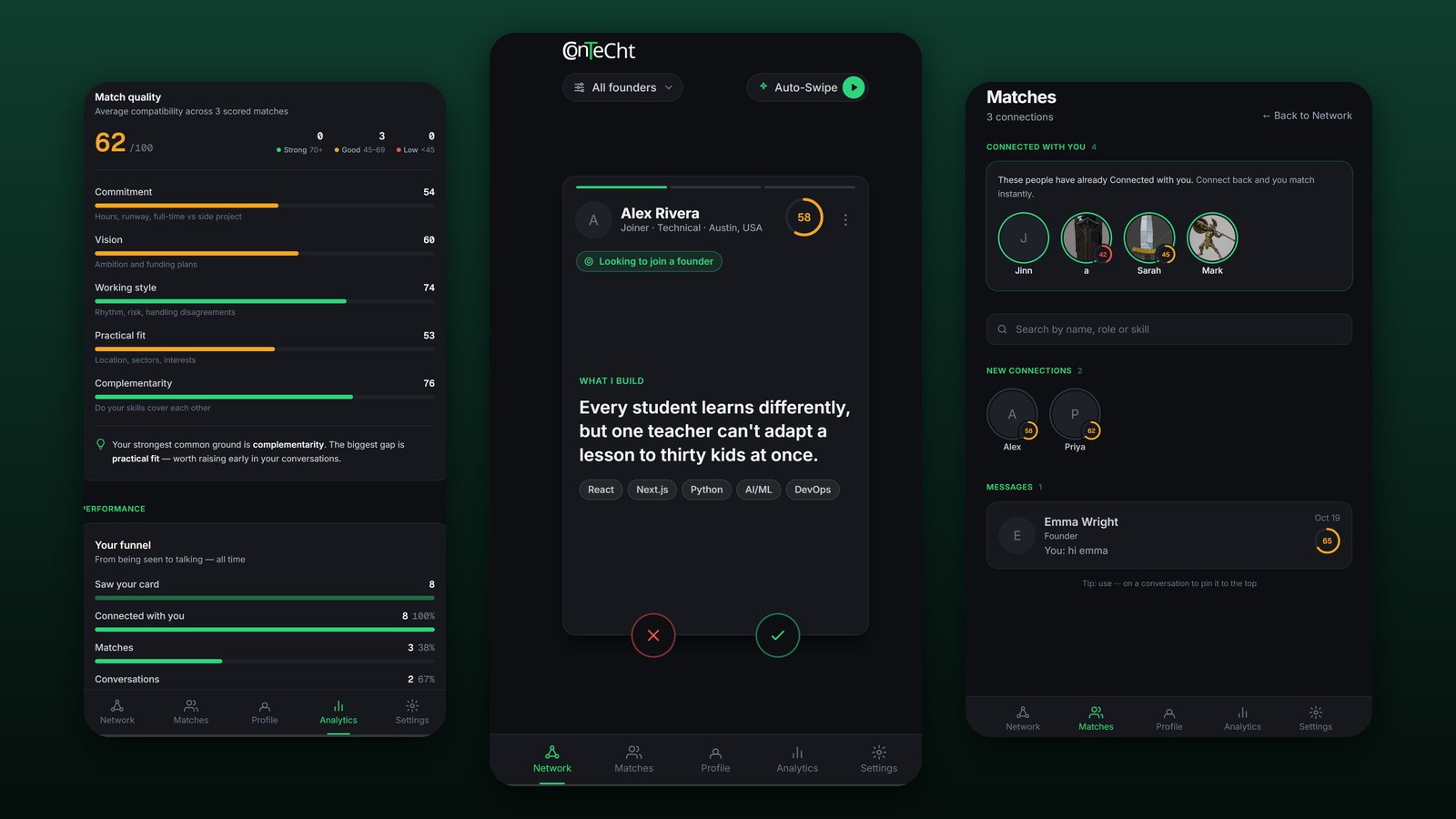
The Network is a card stack with a role filter and a compatibility badge on every card. Connecting with someone who has already connected with you is an instant match, and a celebration screen pushes you straight into the conversation. Premium+ adds Auto-Swipe to keep finding matches while you build.
- Filter by role, swipe or tap the check and cross
- Undo for the last swipe on paid plans
- Mutual connection means an instant match, with the score shown
- A "Connected with you" row lists people who already like you
From card to match
Matches and conversation
Break the blank chat
Matches live in one hub: people who already connected with you, new connections and message threads, with search by name, role or skill and pinned conversations. The first message is the hard part, so each chat opens with starters written from both people's questionnaires, and a call suggestion proposes times in the other person's time zone.
- Starters on commitment, vision and decisions, with a More starters option
- Schedule a call: 30 minutes, a proposed slot, waiting for the other person to pick
- Pin a conversation to the top of the list
- New connections and messages kept in separate sections
From match to call
Plans and analytics
A business model inside the product
Free covers the full questionnaire, compatibility badges, basic filters and messaging with 20 swipes a day. Premium ($9 a month) raises that to 100, sorts the deck by compatibility and adds advanced filters and undo. Premium+ ($19) removes the cap and adds Auto-Swipe, automated outreach and an analytics dashboard.
- Analytics: who connected with you, matches and average score each week
- Who you match with, split by role and by what they bring
- A funnel from seeing your card to connecting, matching and talking
Plans and analytics
Founder decisions
Set the vision, scope and roadmap, and decided what shipped before launch.
Using a mentor
Took feedback from a mentor and acted on it, for example narrowing roles to Founder and Joiner.
Prioritising
Parked legal and marketing work to focus on a working product first.
Improvements & Results
- Role-based onboarding Roles are chosen first, then the questionnaire and profile cards adapt to Founder or Joiner.
- Clearer launch scope Roles narrowed to Founder and Joiner after mentor feedback.
- Scores that explain themselves A five-part breakdown plus a plain-language line on the strongest common ground and the biggest gap, so users know what to discuss first.
- Better first messages Conversation starters and a call suggestion remove the blank-chat problem after a match.
- Full UI overhaul A redesign of the main screens onto one consistent design system.
What I learned
Cut to focus. Narrowing roles before launch made the product clearer, and a score only earns trust when it explains itself. Going from a concept to a working product taught me to plan, prioritise and finish.