A bird flight game you play with real wings
Flap, glide and dive with wings strapped to your forearms. Built in one week for the Alt Control challenge at Design Week Fall 2025, by a team of six.
Overview
- Made for the Alt Control challenge at Design Week Fall 2025: we had to design not just a game, but the controller too.
- Players flap, glide and dive through a sandbox sky using the Wing Cons, two wings that attach along the forearms.
- Our team, Team Gives You Wings, built the game, the wings and the electronics in one week.
Role & Impact
- I designed and built the game side on my own: the terrain, the bird model with animations, the flap, glide and dive code, and working colliders.
- I also worked with the team on how the wings should feel to use, and on the decisions that took the controller from cardboard to the final feathered wings.
Problem
- How do you make a player feel the freedom of being a bird in flight with something other than a gamepad?
- We decided early to focus on the tactility of the action, then had to build a pair of wearable controllers on a very tight deadline.
What I Built
Three gestures, one bird
The whole control scheme fits in three moves, so a new player can fly in seconds.
The game
Playable before the hardware
I built the early playable state of the game myself, so the team could test the controller against a real game from the start.
- A terrain to fly over
- A bird model with animations
- Flap, glide and dive code
- Colliders, so the world pushes back
Game stills
The wing controllers
Wearable, expressive, easy to read
We first tried a back plate, then moved all the electronics onto the wings themselves, and finished with a pair of feathered wings that catch the wind and look striking.
- Two wings worn along the forearms
- Feathers make the controller look and feel like flight
- Each wing is self-contained
The final wings
From cardboard to feathers
How the wing evolved.
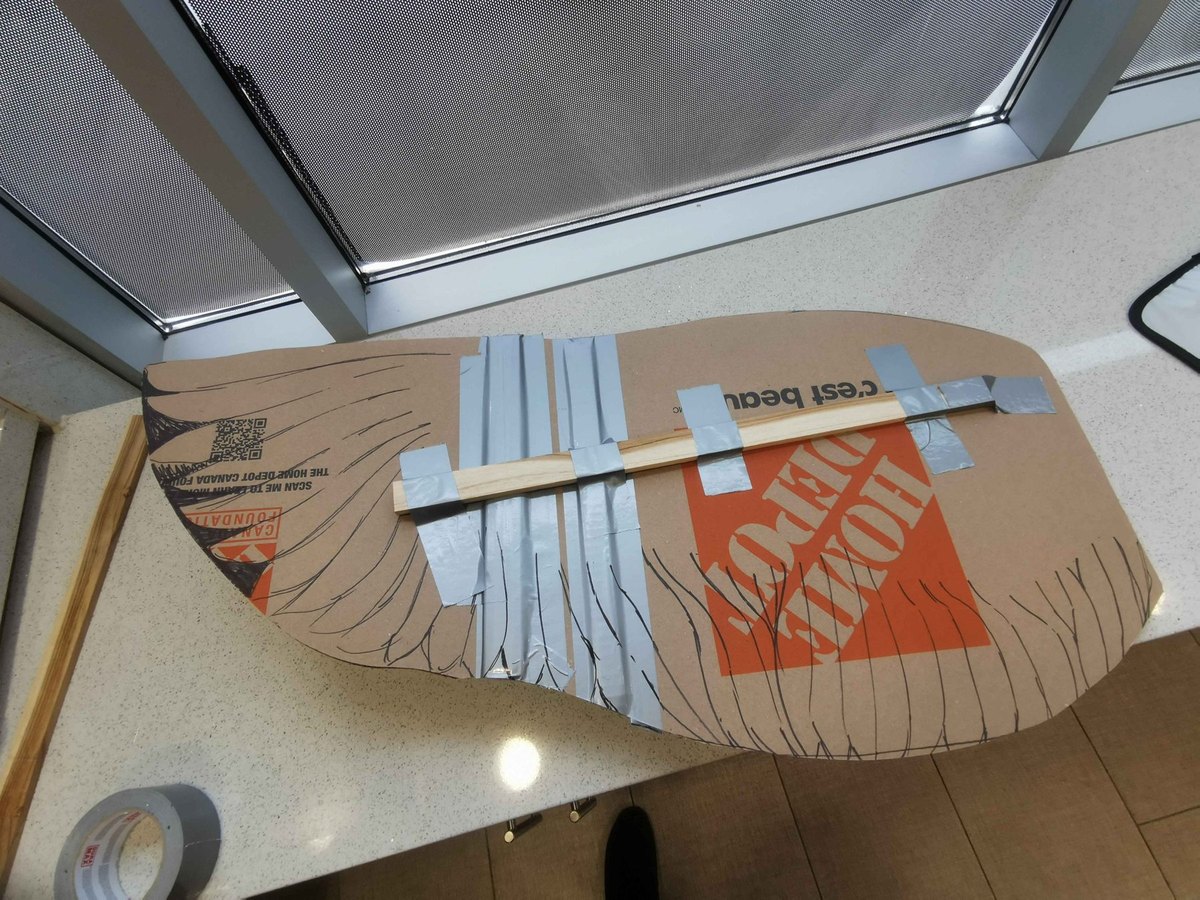
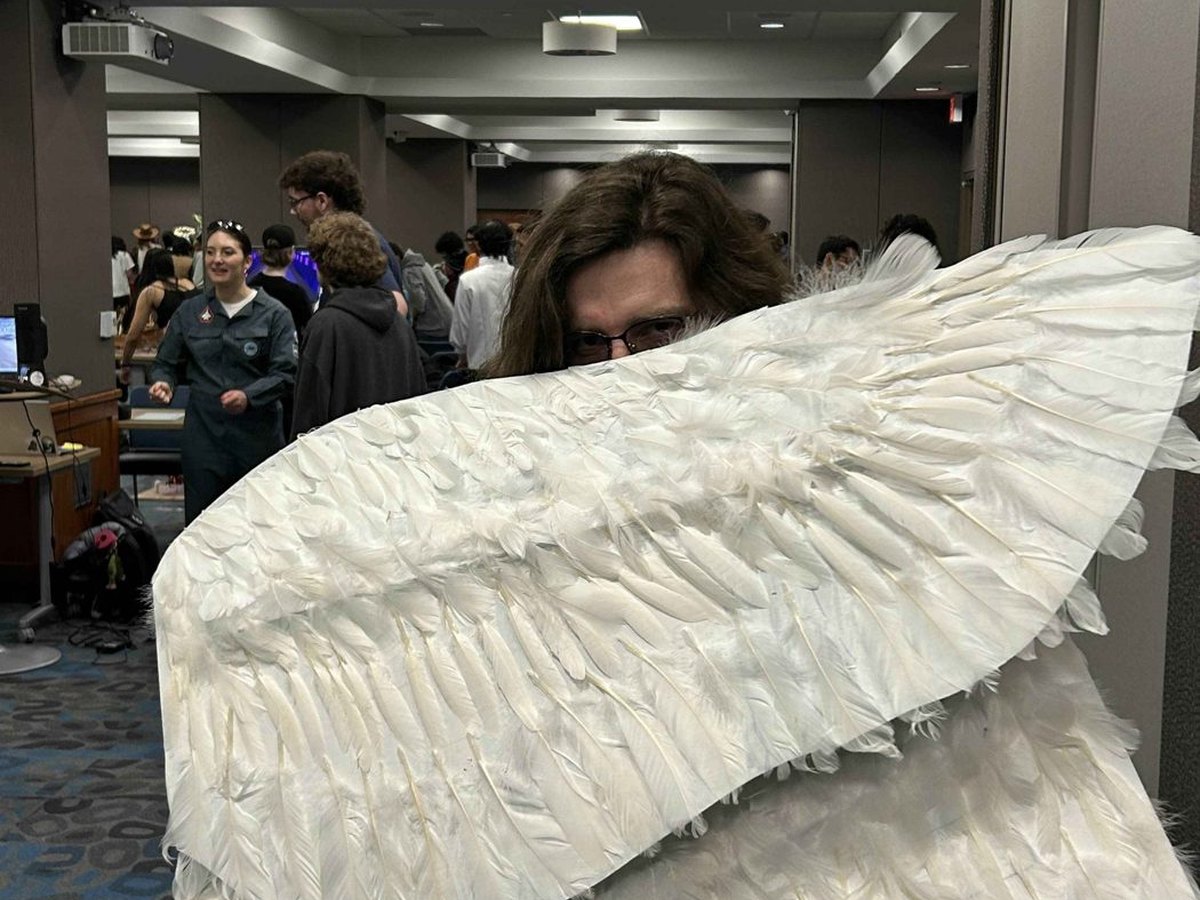 Cardboard prototypeFinal feathered wing‹ ›
From cardboard to feathers
3D-printed wings were too slow to scale, so we built the first wing from cardboard, then covered the final pair in feathers that catch the wind. Drag the bar to compare.
Electronics and straps
Light and quick to repair
Each wing carries its own sensors, wired to an Arduino and breadboard, with elastic straps that hold the wing along the forearm.
- Sensors on each wing, wired to an Arduino and breadboard
- Elastic straps hold the wing along the forearm
- Duct tape and cardboard backing keep the prototype light
Inside the wings
See it in action
Three clips: our Design Week presentation and both prototypes. Each has sound and its own controls.
Design Week presentation
Our team's presentation for the Alt Control challenge: the game, the Wing Cons and how the design evolved.
The team
Prototypes
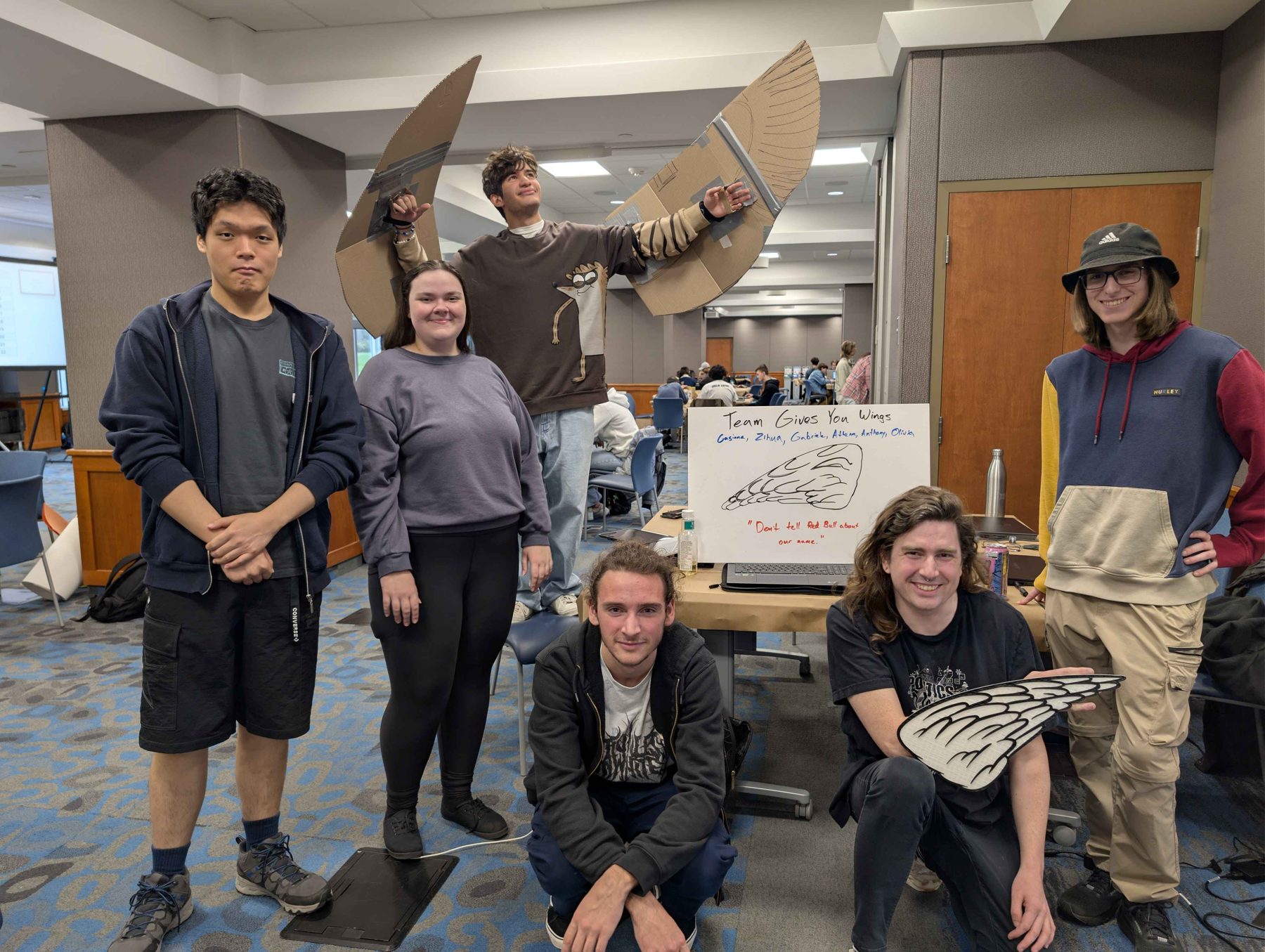
Team Gives You Wings
A team of six built Free Birdie during Design Week Fall 2025. The whiteboard shows our name and the sketch that became the wing design.
Owning the game end to end
I took full ownership of the game so the rest of the team could focus on the hardware, and had a playable build ready to test the controller against.
Decisions under a deadline
As a team we moved electronics from a back plate onto the wings, and from 3D-printed wings to cardboard, when the print scale was too much for the deadline.
Designing around feel
Agreed early to prioritise how flying felt, and judged each prototype against that.
Improvements & Results
- Electronics moved onto the wings Replaced the original back plate so each wing is self-contained.
- Cardboard, then feathers 3D-printed wings were too slow to scale, so we went to cardboard first, then feathers for the final pair.
- Controls that read clearly Flat to glide, flap to climb forward, pull in to dive: three gestures that are easy to tell apart.
What I learned
Embodied input shapes feel. The wings made flight feel expressive instead of mechanical, and the hardest moments were the transitions between gestures. Building the game first meant the team could judge every controller change against real gameplay, and a tight deadline made us choose lighter, faster materials over perfect ones.